
For every Re in govt coffer, one-fourth will come from market borrowing.

Majority expect economy to slow down, but are satisfied with Modi govt's performance.
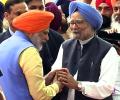
Whether it was the MGNREGS or the NFSA or the Aadhaar-based DBT scheme for cash transfer, the Modi government has built on the basic architecture created by the Singh government. Policy makers in the Modi government, instead of discarding them as products of the previous political regime, worked on them, expanded their scope and reach, and used new tools to improve their performance, explains A K Bhattacharya.

After discussions, there may be changes the Bill.
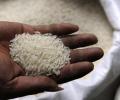
The government on Thursday imposed a 20 per cent export duty on non-Basmati rice except for parboiled rice to boost domestic supplies amid a fall in area under the paddy crop in the current Kharif season. According to a notification by the revenue department, an export duty of 20 per cent has been imposed on 'rice in husk (paddy or rough)' and 'husked (brown) rice'. The Central Board of Indirect Taxes & Customs further said the export of 'semi-milled or wholly-milled rice, whether or not polished or glazed(other than Parboiled rice and Basmati rice)' will also attract a customs duty of 20 per cent.

Pitching for a non-adversarial tax environment, India Inc on Tuesday suggested reduction in tax rates on corporate as well as individuals to boost economic growth.

The implementation of the GST will indeed be a landmark reform.

The Centre's revenue from GST registered a decline of 10 per cent in 2017-18 compared to revenue of subsumed taxes in 2016-17.

An audit conducted by professional services firm Alvarez and Marsal confirms fintech firm's dealings with fake or non-existent vendors.

As the voting process for the new Conservative Party leader formally opened with postal ballots being mailed out to Tory members from Monday, Rishi Sunak vowed to cut the basic rate of income tax by 20 per cent in a few years if he is elected Britain's prime minister.

Early GST rollout to help create more jobs, boost output, says IMF.
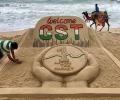
The finance ministry has set up two committees of state finance ministers which would rework rate slabs, review GST exempt items and identify potential evasion sources. Four years after the roll out of the national Goods and Services Tax (GST), which replaced the complex indirect tax structure, the centre and states have started work on moving towards a "simpler rate structure in GST" by reviewing the current rate slabs, including special rates and merger of rate slabs. The Group of Ministers (GoM) on rate rationalisation would also review items under inverted duty structure to help minimise refund payout, and review the supply of goods and services exempt under GST with an objective to expand the tax base and eliminate breaking of input tax credit (ITC) chain.
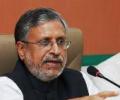
Sushil Kumar Modi, who ceased to be Bihar Finance Minister following the JD (U)-BJP split, on Monday resigned as Chairman of the Empowered Committee of State Finance Ministers looking into the implementation of the proposed new indirect tax regime - Goods and Services Tax (GST).

Any business that makes inter-state supply is outside the ambit of the scheme

According to the NIPFP, there is the possibility that even if the banking system matures over time, some transactions could bypass the system so as not to pay the BTT.

"At present, there are two main rate slabs under which sa majority of goods are covered -- five per cent and 12.5 per cent -- which will now increase to three (five per cent, 12 per cent and 18 per cent).Will this result in multiple litigations is anybody's guess."

Stocks and sectors impacted most by GST.

The annual Finance Bill may soon become far less exciting as the government plans to lift the veil of secrecy surrounding tax proposals in Budget. Once the Direct Taxes Code (DTC) and Goods and Services Tax (GST) are in place, the finance ministry will adopt a public discussion approach for most future decisions, while confining the annual exercise to a few procedural changes.
The CBIC has come out with guidelines on blocking of tax credit by GST field officers, saying that such blocking should be on the basis of 'material evidence' and not just out of 'suspicion'. The guidelines laid down five specific circumstances in which such credit could be blocked by a senior tax officer. These include availment of credit without any invoice or any valid document, or availing of credit by purchasers on invoices on which GST has not been paid by sellers.

The manner in which India has allowed the rule of law to be subverted for over eight years is tragic, notes former additional solicitor general of India Bishwajit Bhattacharyya.

Economic stagnation is the advance payment for polarisation, which extracts a terrible price.

Economist Jayati Ghosh noted that the word 'freebies' indicates the class position of those who use it.

Change in performance appraisal system will deter corruption and motivate officers to pass correct orders.

There has been a sharp recovery in the headline corporate earnings in the April-June 2023 quarter (Q1FY24), after a dismal showing by early bird companies. The combined net profit of the 983 listed companies that have declared their quarterly results, so far, was up 64.7 per cent year-on-year to record a high of Rs 2.68 trillion in the first quarter, but growth in earnings remained lopsided because most of the incremental gains came from a handful of companies. Moreover, the quarterly numbers showed a continued slowdown in revenue growth.

The Narendra Modi government's alacrity in promoting ease of tax administration, a critical component in the ease of doing business index, has set in motion several incremental policy and administrative reforms, says Mukesh Butani.
The Economic Survey states that the rationalisation and reprioritisation of subsidies through better targeting would play a vital role in fiscal consolidation and in targeting expenditure more towards inclusive development.

After comments from the Parliamentary panel, the bill could have been placed in the winter session, and once passed in that session, GST legislation could have been tabled in the Budget session.

GST making you anxious? Here is a fact-check on how new tax will impact you.
A well-functioning GST will enhance tax compliance and boost growth: IMF

A five-judge constitution bench headed by Chief Justice D Y Chandrachud held that the 2018 scheme was 'violative' of the constitutional right to freedom of speech and expression and right to information.

The key now is expenditure control, but how much?

The much awaited new indirect tax regime Goods and Service Tax (GST) is unlikely to be implemented from the scheduled date of April 1, 2011, a top government official said on Tuesday.
The government has decided to compensate states for any revenue loss on account of the implementation of the Goods and Services Tax (GST), a move that will encourage states to go in for the new tax structure scheduled to be implemented from April 1, next year.

He says current arrangement is working fine.
Finance Minister Pranab Mukherjee on Wednesday proposed a three-rate structure for the Goods and Services Tax -- which will simplify the indirect tax regime -- under which goods will attract 20 per cent levy, services 16 per cent and essential items a concessional 12 per cent.
"The roadmap given by Finance Minister Pranab Mukherjee makes it clear that this budget will increase financial burden on common people," CPI(M) leader Sitaram Yechury told reporters outside Parliament.

The Centre and the states are yet to reach at an agreement for goods and services to be included in the GST regime. The decision on a lower levy on food products and exemption to some of them is also yet to be taken.

Parliamentary Standing Committee on Finance Chairman Yashwant Sinha wants the government to first introduce goods and services tax (GST) at the central level and set example for states to implement the indirect tax reform.
The government on Monday expressed its commitment to introduce a uniform indirect tax structure across the country, GST, from the next fiscal after consultation with states.

A few companies continue to pay taxes at 15-20%.
 © 2026 Rediff.com - Advertise with us - Disclaimer - Privacy Policy - Sitemap - Feedback - About us - Terms of use - Grievances